
On 12 September, the finals of the 14th “Venture Jiangsu” Science and Technology Entrepreneurship Competition and the Jiangsu Division of the 15th China Innovation and Entrepreneurship Competition concluded in Nanjing. MoSense secured the Team Group Championship with its project “Electromagnetic Metamaterial Flexible Electronic Skin and Multimodal Fusion Perception Model”, standing out from 4,838 registered entries. This marks MoSense’s third championship win at a major entrepreneurship contest within a single month, following its double victories at the HICOOL 2026 Global Entrepreneurs Competition and the HKUST Million Dollar Innovation Competition (Shanghai Division).
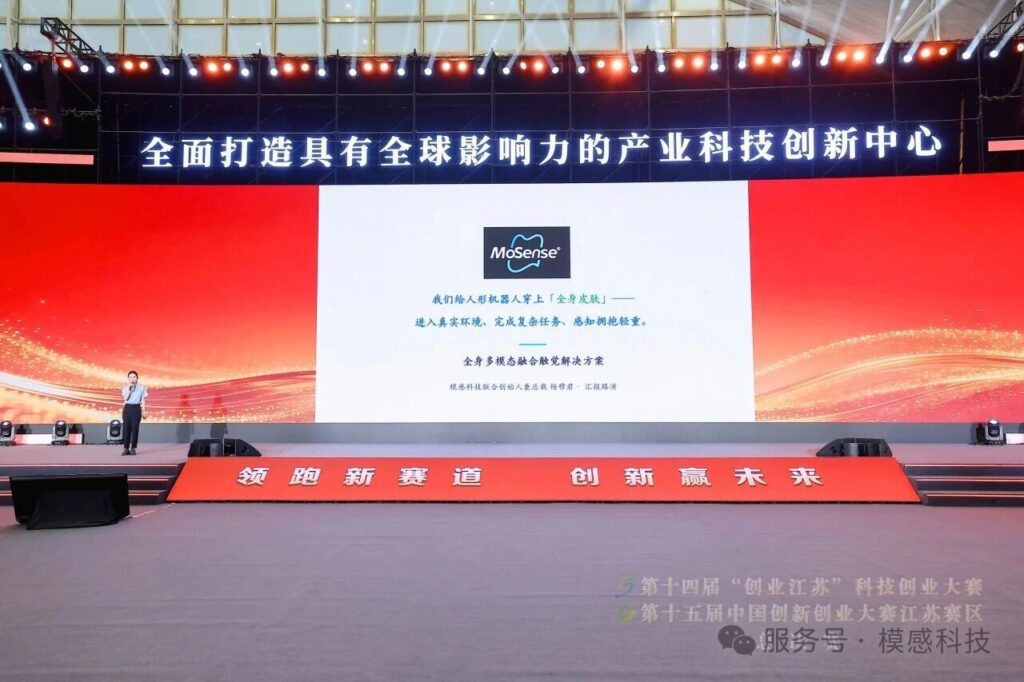
Since its launch in May, this competition has attracted a total of 4,838 registered projects, including 2,210 entries in the Team Group and 2,410 entries in the Enterprise Group, alongside 218 projects for the dedicated AI OPC Special Competition. Following recommendations from regional contests and successive rounds of provincial sectoral evaluations, only 60 projects advanced to the grand finals.
MoSense delivered an 8-minute presentation and a 5-minute Q&A session at the AI + Industry Competition held in Nantong Economic & Technological Development Zone. Having qualified for the grand finals as the top-ranked contender in the semi-finals for the Team Group, the company stood out once again at the final showdown and claimed first place with an outstanding performance.
At the grand finals, Yang Mujun, Co-founder and President of MoSense, took the stage for her pitch. Centred on the theme of “Full-body Multimodal Fusion Tactile Solution”, she demonstrated the full-body multimodal fusion tactile solution to judges and the audience, enabling robots to operate in real-world environments, execute complex tasks and perceive the force of a gentle embrace.

As humanoid robots gradually move from demo showcases to practical applications in manufacturing, services and other sectors, vision and hearing alone are no longer sufficient. The capacity to sense external stimuli such as contact, pressure and temperature has become a critical factor enabling robots to further integrate into the real world.
Yang Mujun, President of MoSense, explained that the team is developing a full‑body multimodal fusion tactile solution, aiming to equip robots with “electronic skin” that delivers wider coverage and finer perception. With the accelerated advancement of embodied intelligence, this “skin” may emerge as a new competitive frontier for robotic perception capabilities, following vision and hearing.
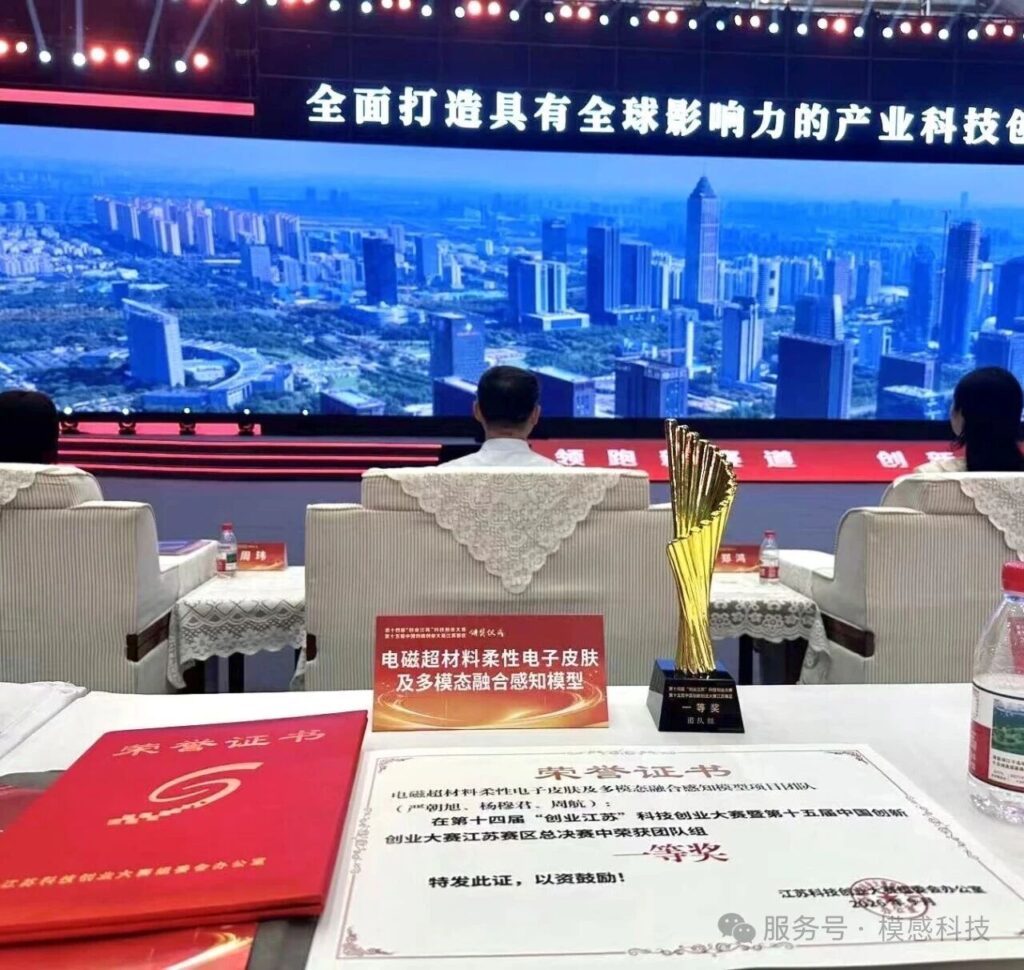
From 13 to 14 August, the team participated in the AI + Industry Competition at Nantong Economic & Technological Development Zone. On 12 September, they took to the grand final stage in Nanjing and delivered an 8-minute presentation followed by a 5-minute judges’ Q&A session.
The competition evaluation spanned multiple dimensions, including technological and product innovation, industry and market prospects, business models, implementation plans and team management. MoSense’s project entitled “Electromagnetic Metamaterial Flexible Electronic Skin and Multimodal Fusion Perception Model” ultimately claimed the Team Group Championship.
This marked a full-scale practical exercise for MoSense on the Venture Jiangsu track, and a milestone where its technical direction was recognised by provincial competition judges. From the industry competition in Nantong in August to the grand finals stage in Nanjing in September, the MoSense team answered a core question through a complete pitch: for humanoid robots to enter the real world, it is not enough merely to see and hear — they also need the ability to “touch”.
This championship honour affirms the team’s technical roadmap and serves as a starting point for further progress. We thank the judges, partners and all friends who support and recognise MoSense.